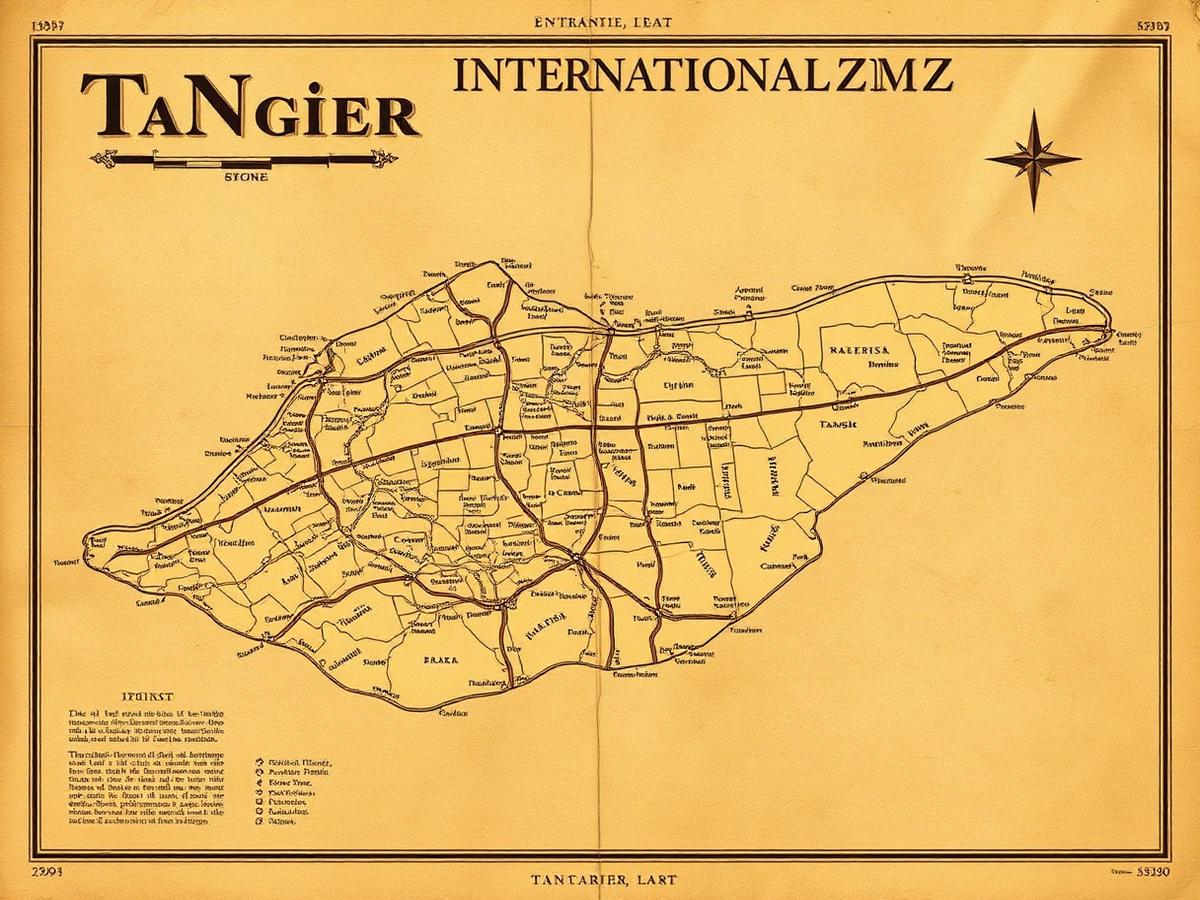
Tangier International
American Legation, cafés, Marshan and diplomatic atmosphere.
Estimated duration
Half day
Difficulty
Easy
Best time to visit
Morning
In the footsteps of the International Zone
From 1923 to 1956, Tangier lived under an international regime run by several European powers alongside Morocco. That parenthesis left a visible imprint: legations, banks, cafés, multilingual press and cosmopolitan villas. This walk does not try to retell the whole history but to let a few still-readable places speak. Many landmarks have been transformed or lost: we focus on what you can actually visit today, without artificially recreating a lost atmosphere.
What is still readable
Three anchors carry most of it: the American Legation, open to the public in its historic medina building; the Grand Socco square with Cinéma Rif and its interwar blocks; and the streets around Boulevard Pasteur, where a few cafés and façades still hold memory of the 1930s-50s. The Cervantes Theatre, a strong symbol of the era, can be seen from the street but its state of conservation shifts — ask locally before hoping to go in.
How to read this past without romanticising it
The international imaginary — writers and spies — is real but partial: it involved a cosmopolitan elite and left aside much of the Moroccan population. Read each place on two levels: what it represented for that milieu and what it represents today, in a fully Moroccan city. This reading avoids nostalgic projections and does justice to Tangier's much deeper history.
Extending the historical reading
To deepen this walk, pair it with the International Zone entry in the History section, which lays out the legal framework, languages and institutions of the period. You can also pass through Marshan, a former upscale residential district whose villas hint at 20th-century cosmopolitan life. Ending at a historic Petit Socco café gives the whole a sensory anchor, without artificial recreations and without mistaking one elite's nostalgia for the whole city's experience.
Good to remember before you set off
Many buildings mentioned are private or of unclear status: admire the façades from the street and don't force any entrance. The real opening hours of the few visitable places can change without notice, so it pays to check ahead. Keep a simple fallback in mind, like a café or a pause at the Grand Socco, in case a site is closed on the day you walk by.