Back to Home
Carpets
Berber rugs, kilims and unique pieces.
Practical tips
Take time, listen to the piece's story.
Good to know
Prices can change depending on season, provider or availability. Please check the official website or Google Maps before going.
Overview
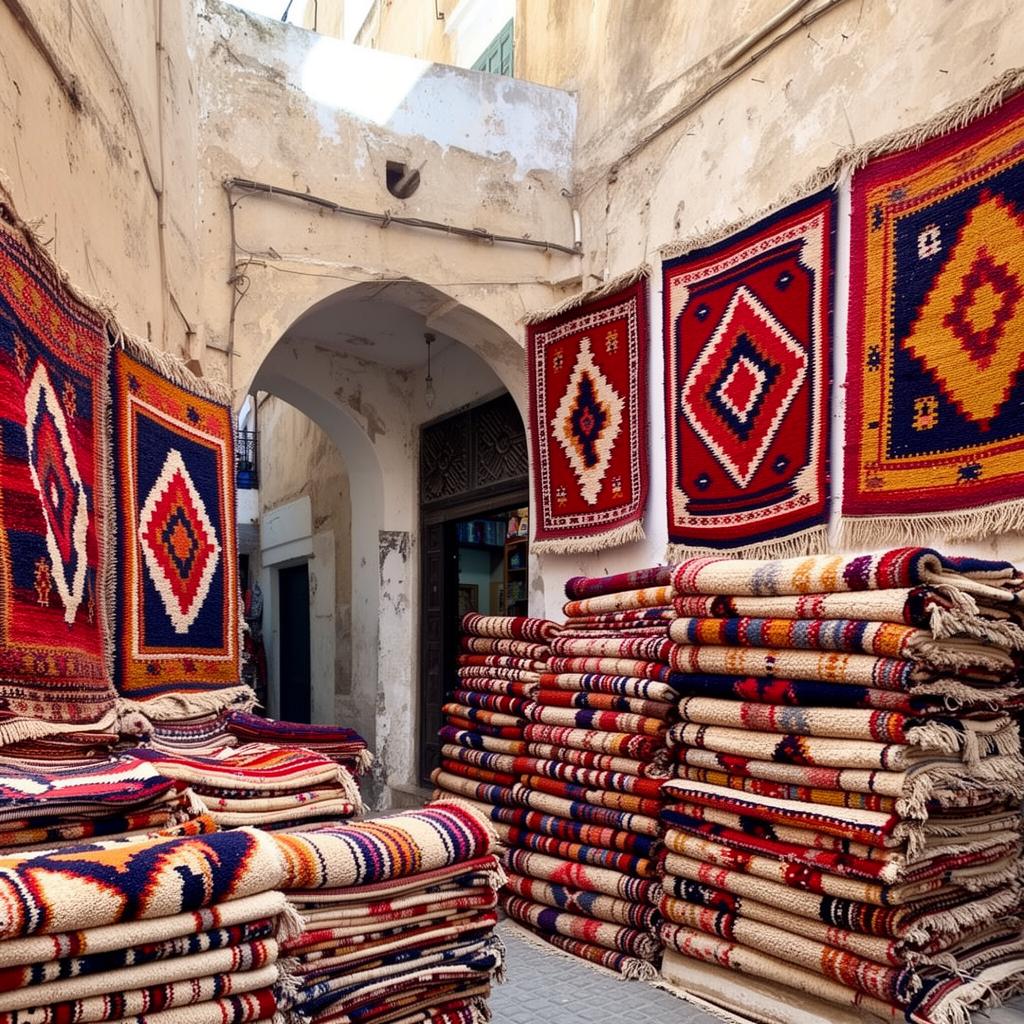
Moroccan carpets are not a single family: each region weaves its own style, motifs and materials. In Tangier you'll mostly see pieces from the Middle Atlas, the Rif and Rabat, shown in the medina and around the Petit Socco. Taking time to compare several shops before buying is the best way to avoid regrets.
Types and styles to know
- Beni Ouarain: thick ivory wool, black or brown diamonds, Berber tribes of the Middle Atlas. Warm, comfortable and instantly recognisable.
- Boucherouite: rag rug made of recycled cotton and textile strips, each piece unique. Light, modern and often cheaper.
- Kilim (hanbel): flat-weave with no knots, geometric motifs, reversible. Great for a light-weight living room or as a wall piece.
- Rif carpets: northern Morocco, more rustic wool, stripes and bright colours, often woven by women's cooperatives.
- Rabat carpets: urban style, higher knot density, floral motifs of Arab-Andalusian inspiration. More formal pieces.
- Azilal, Boujaad: also Middle Atlas, more colourful than Beni Ouarain, free almost childlike drawings. Usually one-of-a-kind.
How to recognise quality
- Flip the carpet over. On a handmade piece the pattern stays crisp on the back and each knot is visible. A rubberised, glued or perfectly uniform back gives away industrial production.
- Feel the wool. Real wool is slightly greasy to the touch (lanolin), not plastic, not too slick. A faint natural wool smell is a good sign.
- Check the fringes. They should be an extension of the warp, not sewn on separately. Attached fringes often hide an industrial piece.
- Look at regularity: handmade carpets have small irregularities in knots, colour and size. A totally symmetric, flawless piece is suspicious.
- Ask for the region of origin and the cooperative or village name. A serious seller answers without hesitation.
- Dyes: natural (indigo, henna, pomegranate) or synthetic? Rub a damp corner with a white tissue — a good dye should not bleed strongly.
Checklist before you pay
- Exact measurements taken at home, with tape on the floor to visualise.
- Photos of the carpet in daylight, including the back.
- Clear invoice with description, dimensions, declared material and final price in dirhams.
- Final price stated in dirhams (MAD), not only in euros or dollars.
- Clarified payment method (cash, card, transfer) and a receipt handed on the spot.
- Cooperative label or signature if the piece claims to come from one.
Bargaining with respect
- Visit several shops before discussing price. That gives you a realistic range in the medina.
- Accept tea if offered, with no obligation to buy. It's not a trap, it's local hospitality.
- Bargain with a smile, one honest counter-offer, not haggling over every dirham.
- If the price won't come down and you truly love the piece, it's fine to pay the asking price. Respect over haggling.
- Never name a price you're not ready to pay. A serious counter-offer commits you.
Mistakes and red flags
- Buying the first carpet you see on day one, no comparison.
- Being rushed by a pushy seller or a street guide on commission.
- Paying in euros at a rate set by the seller instead of dirhams.
- Accepting “pure wool” without checking the back or smelling the fibre.
- Forgetting the size — measuring at home avoids an over- or under-sized carpet.
Take home, shipping, customs
- Small carpets: roll them tight and they fit in cabin or hold luggage. Many airlines accept a rolled carpet as a second bag.
- Large pieces: ask for international shipping with a carrier (DHL, FedEx, Moroccan Post). Get weight, dimensions and price written down.
- Insurance and tracking: insist on a tracking number and, for expensive pieces, insurance declared at true value.
- Customs: entering the EU, a carpet above a certain value may be subject to import VAT. Check with your customs before to avoid surprises.
- Detailed invoice: essential for insurance, customs, or future resale. Refuse any shipment without one.
Useful Darija phrases
- بشحال هادي؟How much is this?
- واش مصنوعة باليد؟Is it handmade?
- شنو المادة ديالها؟What is it made of?
- شحال الثمن الأخير؟What's the final price?
- واش تقدروا تصيفطوها لبلادي؟Can you ship it to my country?
- بغيت فاتورة عافاك.I'd like an invoice, please.
On Google Maps
Ask Luna
Frequently asked questions
Berber rugs (Beni Ouarain, Boucherouite), flat kilims, Rif rugs and more formal Rabat rugs. Ask about origin, materials (wool, cotton) and check the knot regularity.